
A mobile coffee cart is worth considering when moving the service point is part of the operating plan. A fixed coffee kiosk deserves consideration when the business is organised around one location. Neither format is automatically cheaper, easier to operate or more profitable. The useful comparison starts with your menu, your site and what happens before and after each service period.
For this comparison, a cart means a wheeled service unit intended to be repositioned; a fixed kiosk means a counter arrangement planned for a designated trading space. These are planning descriptions, not guarantees about the construction, equipment or permissions included in a particular quotation.
Decide what mobility must achieve
Write down where the coffee cart will actually move: from storage to a lobby, between rooms at an event, or between separate venues. Those are different requirements. A short indoor route does not establish that the same cart can be loaded into a vehicle or moved across an outdoor surface. Check the route dimensions and discuss the fully equipped unit with the supplier.
For a traditional coffee kiosk, establish the permitted footprint and the positions of neighbouring units, public circulation and staff access. If relocation is only a future possibility, ask how the counter could be dismantled rather than ruling out a kiosk because it has no wheels.
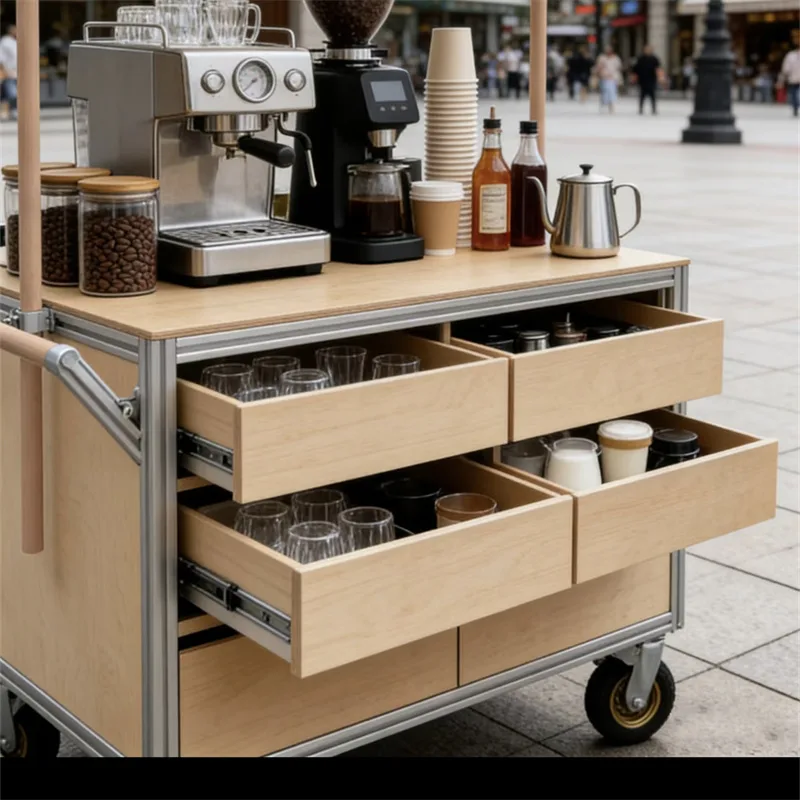
Compare the complete equipment arrangement
Make one equipment list for the intended menu before comparing the two formats. Include each appliance's dimensions and supplier installation requirements, as well as cups, packaging and the other items occupying the worktop. Mark which items belong to the counter order and which you will purchase separately.
A cart should not be treated as a ready-to-trade coffee business simply because an illustration shows an espresso machine. Likewise, a kiosk drawing is not a confirmed utility layout. Identify who is responsible for power, water, drainage and any other required services. Confirm food-handling requirements and operating permissions with the responsible local specialists rather than inferring them from the fixture format.
Walk through an order in both layouts
Draw the same sequence for each option: order taking, drink preparation, finishing and collection. Position the actual equipment on the drawing, then add the people using it. If two staff members will work together, consider where they pass and which surfaces they share.
A compact cart may suit a deliberately limited service arrangement, but that needs to be tested against your menu. A larger kiosk can provide more counter space only if the approved footprint allows it. Avoid choosing from the exterior length alone; doors, equipment clearances and storage access all affect the usable working area.
Include setup, replenishment and closing
Compare the work that happens outside customer-facing service. For the cart, list what must be loaded, secured, moved and unpacked each time. Identify the storage location and how consumables reach the service point. Ask how the equipment is protected during the movement you intend.
For the kiosk, mark replenishment access and the place for supplies that do not fit inside the counter. Discuss the closing arrangement with the venue and note any restrictions on leaving items visible. Neither format removes the need for an agreed cleaning, maintenance and equipment-care routine.
Compare quotations on the same basis
Use two columns with the same headings: furniture, appliances, graphics, delivery, installation and site-related work. Record exclusions next to each quoted amount. Keep recurring operating expenses separate from the initial purchase so the counter price does not become a stand-in for the whole business budget.
Leave unknown costs marked as unknown until you have evidence. A cart requiring transport and repeated setup may compare differently from one stored beside its trading position. A kiosk using existing services may compare differently from a new fit-out. There is no reliable universal saving to apply to every project.
Choose the format that matches a documented brief
Bring the comparison back to the operating requirement. If regular movement is essential, resolve the route and equipment constraints before selecting a mobile coffee cart. If a designated location is central to the plan, develop the fixed counter around its approved footprint and service connections.
Send Benson Display the same menu outline, site information and equipment list for either option. Include reference images as visual direction, not as a substitute for specifications. You can share your coffee cart or kiosk brief with the unresolved questions listed clearly, so the proposed fixture scope can be checked before a purchase decision.